ASTM D1415 is a test method for measuring the international hardness of vulcanized and thermoplastic rubber using a ball indentation approach and reporting results in International Rubber Hardness Degrees (IRHD).
If you are unsure whether IRHD is the right hardness approach for your part geometry, thickness, or acceptance criteria (versus Shore durometer), talk with our team about your application before locking in a test setup.
ASTM D1415 — Standard Test Method for Rubber Property—International Hardness
ASTM D1415 defines an indentation-based hardness procedure for rubber materials that converts measured penetration behavior into an IRHD hardness value. It is commonly used where a controlled, instrumented indentation method is preferred for rubber compounds and finished rubber parts.
This method uses a specified ball indenter and compares penetration under a small initial contact force and a larger final force, with the differential penetration converted to IRHD.
Quick Definition
ASTM D1415 (IRHD hardness): A rubber hardness test method that measures the change in ball indentation depth between an initial (minor) force and a final (major) force and reports hardness as International Rubber Hardness Degrees (IRHD).
What This Standard Covers
ASTM D1415 covers a procedure for measuring the hardness of vulcanized or thermoplastic rubber. The method is based on differential indentation depth of a specified ball under two force conditions, measured at a specified time and converted to a hardness scale value.
The ASTM D1415 approach is technically similar to ISO 48.
Why This Standard Matters in Testing
Hardness is widely used as a fast, practical check for compound consistency and part-to-part variability. With ASTM D1415, the measurement is tied to controlled ball indentation behavior and expressed on the IRHD scale, which is often specified for rubber products where repeatability and comparability are important.
In many rubber QA/QC workflows, IRHD results are used to support lot release decisions, incoming inspection, and process monitoring alongside other physical properties.
Common Materials, Product Types, or Applications Covered
ASTM D1415 is used for vulcanized rubber and thermoplastic rubber materials. It is commonly applied to rubber compounds and finished parts where indentation hardness is part of the specification.
Common examples: Rubber sheets and plaques, molded rubber components, seals and similar elastomer parts (where the specimen geometry and thickness are appropriate for the selected IRHD method).
Common Test or Verification Workflow
A typical ASTM D1415 workflow includes selecting the applicable IRHD method for the specimen type, preparing a smooth and stable test surface, and performing multiple measurements across the specimen to reduce local surface and geometry effects.
Typical workflow steps:
- Condition the specimen and test environment as required for consistent hardness readings.
- Apply the minor (initial) force to establish contact, then apply the major (final) force.
- Measure the differential indentation (penetration depth change) at the specified time(s).
- Convert the measured penetration difference to an IRHD hardness value using the standard’s conversion approach.
- Report the required statistic (commonly a central value such as a median) from multiple points.
Equipment Commonly Used for This Standard
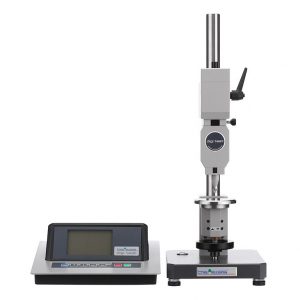
ASTM D1415 typically points to an IRHD hardness tester (a stationary, instrumented hardness system) rather than a handheld durometer. The key equipment function is controlled ball indentation with defined minor/major forces and accurate indentation-depth measurement.
Common equipment elements:
- IRHD hardness tester with a ball indenter and a controlled force application system (minor and major forces).
- Rigid specimen support (anvil/table) designed to hold parts flat and stable during indentation.
- Depth/displacement measurement and a readout that reports hardness in IRHD (often with automated conversion).
- Optional fixtures or supports for small parts (for example, seals) where positioning and stability affect repeatability.
Practical purchasing note: IRHD testing is method- and specimen-dependent. The instrument configuration (indenter/force range, supports, and automation level) should match the IRHD method referenced in your customer specification and the geometry of the parts you need to test.
How to Read This Designation or Revision
ASTM standards are commonly cited by designation plus an edition year, sometimes with a later reapproval year shown in parentheses. For example, ASTM D1415-18(2026) indicates a 2018 edition that was reapproved in 2026.
Revision sensitivity: Test conditions, timing, allowable specimen ranges, and reporting expectations can vary by edition. When quoting equipment or setting up work instructions, match the exact ASTM D1415 edition cited on your drawing, purchase order, or material specification.
Related Standards, Methods, or Frameworks
ISO 48: ASTM D1415 is technically similar to ISO 48, and IRHD is commonly discussed alongside ISO-based hardness requirements.
ASTM D2240 (Shore durometer hardness): Shore durometer and IRHD are both indentation hardness approaches used for elastomers, but they are not equivalent instrument types or methods. For rubber vulcanizates in the usual range of resilience and on standard specimens, IRHD values may be comparable to Type A durometer readings; however, differences in dwell time, viscoelastic response, and specimen geometry can drive differences between the methods.
Get a Quote for ASTM D1415 (IRHD) Test Equipment
If you are selecting an IRHD hardness tester or accessories for rubber parts testing, you can request a detailed quote with the IRHD method, specimen geometry, and throughput matched to your lab workflow.