GenBally Flex – Resistance Flexing Tester

Textile Testing Equipment
Standards
- AS/NZS 2210.2 Section 6.6.2.8
- ASTM D6182
- BS 3144 Clause 13
- DIN 53351
- EN 344-1 Section 5.13.1.3 and Annex C
- EN 13512
- EN ISO 20344:2021 Section 6.6.3
- GB/T 20991 Section 6.6.2.8
- GE-24
- ISO 5402-1
- ISO 17694
- ISO 32100
- IULTCS / IUP 20-1
- JIS K 6545
- SATRA TM 55


Description
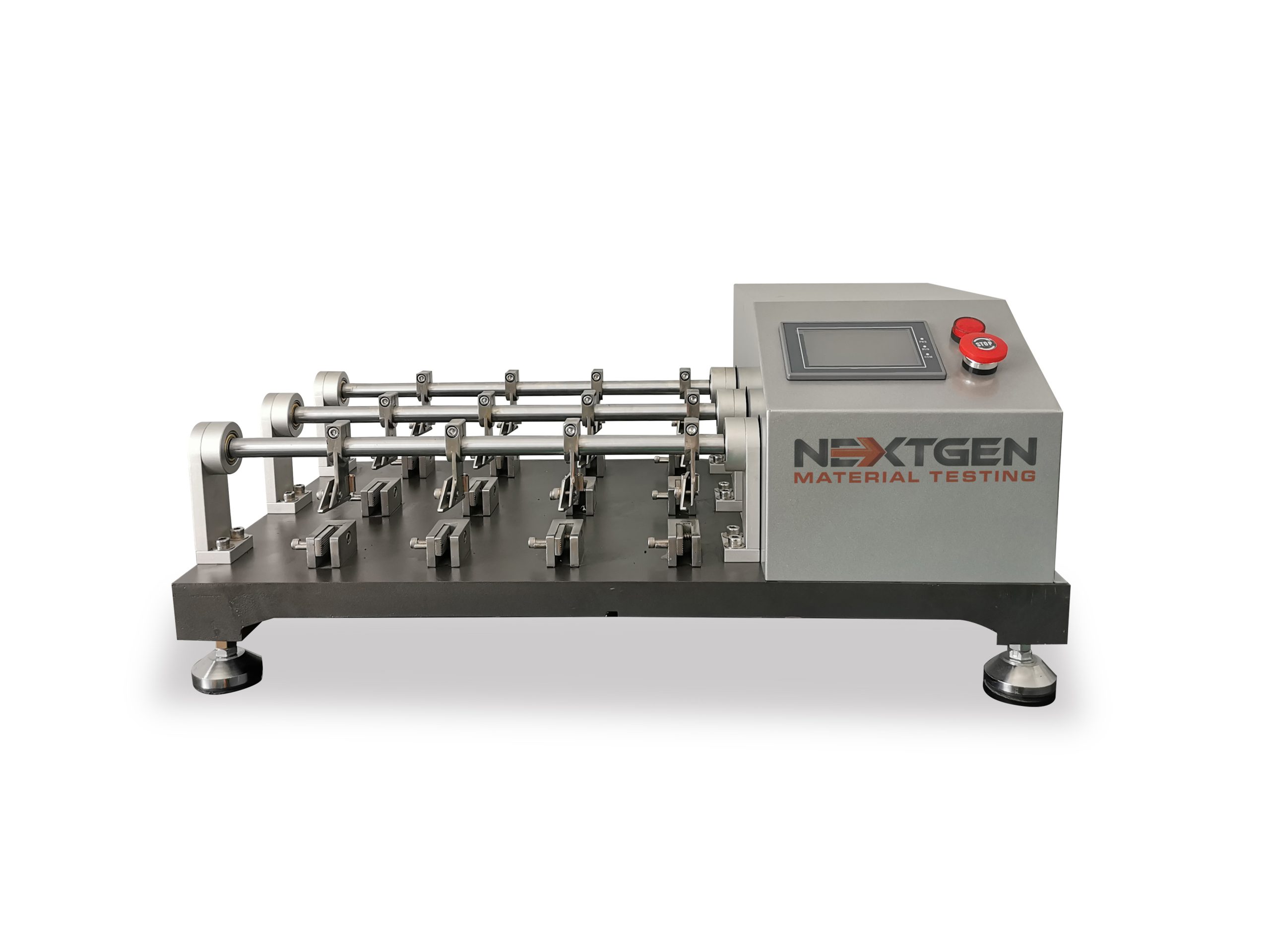
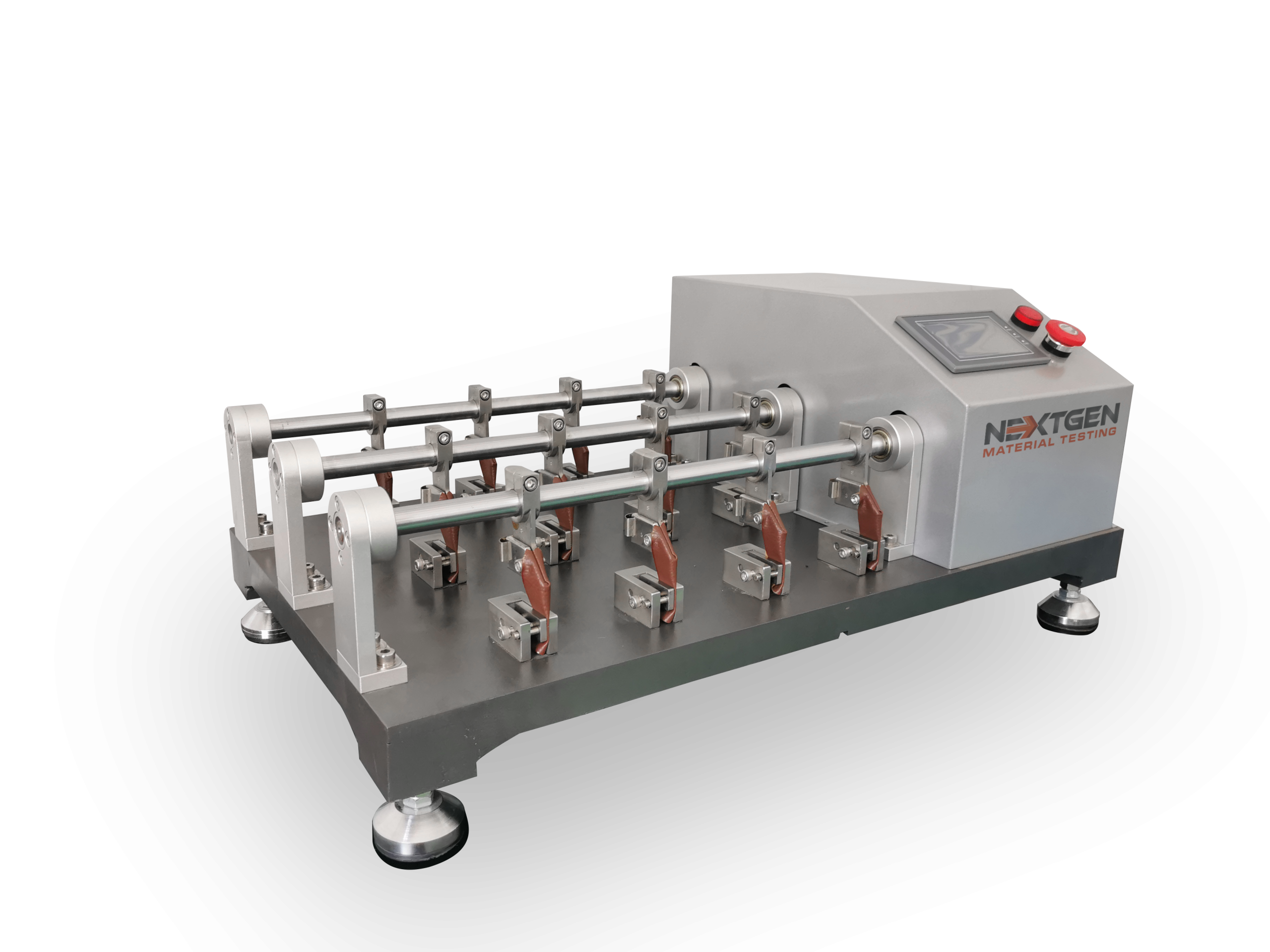
GenBally Flex is a multi-station resistance flexing tester designed to determine how flexible materials perform when repeatedly bent at a defined angle over extended test cycles. It is used to evaluate cracking, crease failure, and flex-related damage in leather, coated fabrics, and textile materials commonly used in footwear uppers and other flexible constructions. With adjustable cycle counting, touchscreen control, multiple station configurations, and defined clamping geometry, GenBally Flex gives laboratories a controlled method for assessing long-term flex durability under standardized conditions. It is well suited for footwear and leather testing programs where repeatable crease formation and failure resistance are critical indicators of material performance.
Main Features
GenBally Flex is designed for labs that need repeatable cyclic flex testing, controlled specimen clamping, and practical throughput options for leather and footwear material evaluation.
- Resistance Flexing Evaluation: Designed to determine resistance to cracking and other failure types that develop at flexing creases under repeated bending.
- Applicable to Flexible Material Systems: Particularly suited for leather, coated fabrics, and textiles used in footwear uppers and similar flexible constructions.
- Defined Bally Flex Test Geometry: The specimen is folded, clamped, and flexed through a controlled angle to create repeatable crease stress during the test cycle.
- Multiple Station Configurations: Available in 6-station, 12-station, and 24-station versions to support different throughput levels in routine testing.
- Touchscreen Control: Uses touchscreen control for parameter setup and routine operation.
- Adjustable Counter: Supports programmable cycle counting up to 999,999 for longer-duration durability testing.
- Controlled Flexing Conditions: Operates at a defined flexing angle and speed to improve repeatability across test programs and material comparisons.
- Upper Grip Configuration Options: Supports different upper grip types depending on the standard and method being used. Supported methods are grouped by A-type and B-type upper grips in the standards section below.
- Compact Multi-Position Layout: Provides higher testing capacity without requiring a large overall footprint, especially in the 6-set and 12-set configurations.
Applications
GenBally Flex is intended for laboratories and manufacturers that need to evaluate how flexible materials respond to repeated creasing and bending over time. It is especially useful where crack resistance, fold durability, and upper-material performance are key quality indicators. Bally flexing methods are widely used in leather and footwear testing because they provide a controlled way to compare flex-related failure resistance across materials and finishes.
- Leather Upper Testing: Flex durability evaluation for leather used in footwear uppers and related products.
- Coated Fabrics: Crack resistance testing for coated materials subjected to repeated bending in service.
- Footwear Materials: Useful for comparing upper constructions, finishes, and flexible components under cyclic flexing.
- Material Qualification and Benchmarking: Supports comparison of materials, finishes, and suppliers during development and sourcing programs.
- Quality Control and Durability Programs: Appropriate for routine verification of flex resistance in manufacturing and lab settings.
Who This System Is For
GenBally Flex is well suited for organizations that need repeatable flex resistance data as part of a leather, coated-fabric, or footwear testing workflow.
- Footwear manufacturers
- Leather material suppliers
- Coated fabric manufacturers
- Footwear and leather quality laboratories
- Product development and material engineering teams
- Independent testing laboratories
- Brands and sourcing teams reviewing upper-material durability
Technical Specifications
For labs comparing Bally flexing systems or planning installation, the specifications below summarize the main station options, operating parameters, and physical requirements of the system.
| Model | GenBally Flex-6 | GenBally Flex-12 | GenBally Flex-24 |
|---|---|---|---|
| Test Position | 6 Sets | 12 Sets | 24 Sets |
| Control Mode | Touchscreen control | ||
| Type of Upper Grips | Selected according to the applicable standard and method | ||
| Flexing Angle | 22.5° +/- 0.5° | ||
| Flexing Speed | 100 +/- 5 cycles per minute | ||
| Counter | 0 - 999,999 (adjustable) | ||
| Sample Size | 2.8 x 1.8 in. (70 +/- 5 x 45 +/- 5 mm) | ||
| Power Supply | 1-phase AC 220 V, 50/60 Hz | ||
| Dimensions (L x W x H) | 27.6 x 11.8 x 13.4 in. (700 x 300 x 340 mm) | 30.7 x 17.7 x 14.2 in. (780 x 450 x 360 mm) | 43.3 x 20.1 x 8.7 in. (1100 x 510 x 220 mm) |
| Weight | Approx. 99.2 lb (45 kg) | 132.3 lb (60 kg) | 154.3 lb (70 kg) |
Standards
GenBally Flex supports recognized flex resistance methods used in leather, coated fabric, and footwear material testing programs. The supported methods are grouped by upper grip type.
A-Type Upper Grips
- SATRA TM 55
- IULTCS / IUP 20-1
- ISO 17694
- EN 13512
- EN 344-1 Section 5.13.1.3 and Annex C
- GB/T 20991 Section 6.6.2.8
- AS/NZS 2210.2 Section 6.6.2.8
- JIS K6545
- BS 3144 Clause 13
B-Type Upper Grips
- ISO 32100
- DIN 53351
- ISO 5402-1
- GE-24
- ASTM D6182
- EN ISO 20344:2021 Section 6.6.3
Standard Accessories
GenBally Flex is supplied with the basic components required for standard system operation.
- Power Line: 1 pc
Optional Accessories
Optional accessories are available for labs that want to streamline specimen preparation for Bally flex testing.
- Pneumatic Sample Cutting Machine: Cutter size 2.8 x 1.8 in. (70 +/- 5 x 45 +/- 5 mm)
Need a Bally Flex Tester That Matches Your Material and Throughput Requirements?
If your lab is testing leather, coated fabrics, or footwear upper materials for flex cracking and crease durability, GenBally Flex can be configured to match your workflow and applicable method. Send NextGen Material Testing your material type, target standards, preferred station count, and sample requirements, and our team will help you review the right setup and prepare a quote for your application.
For Laboratories
Need Additional Quality Control Equipment to Build Your Laboratory?
Footwear and leather testing is only one part of a complete quality control laboratory. NextGen can help you equip your entire lab with color fastness testers, abrasion testers, bursting strength testers, tearing testers, flexing testers, and other supporting solutions, all coordinated as one complete project.
- One partner to equip your complete laboratory
- Installation, training, calibration
- Support for the life of the equipment
FAQs
For a Bally flex tester, those settings should be verified on a regular lab schedule, then rechecked after maintenance, relocation, or any sign that results are drifting. This system runs with a defined flexing angle, controlled cycle speed, and an adjustable counter, so keeping those three items in check is important for repeatable flex cracking and crease durability data.
The right interval depends on your SOP, test volume, and whether the unit is being used for routine QC, supplier comparison, or compliance work. For higher-throughput labs, it is common to verify the setup more often because frequent cycling and fixture changes can affect consistency. The key point is to confirm the angle, speed, and cycle count before critical runs, not just after problems appear.
To align this with your testing method, learn more about the system or request a quote if you want help confirming the right setup, station count, or verification approach for your lab.
This tester supports a broad flex-resistance method set for leather, coated fabric, and footwear materials, with the standard list organized by upper grip type. For method selection, the key is matching the grips and test setup to the standard you need.
For A-type upper grips, the supported methods are SATRA TM 55, IULTCS / IUP 20-1, ISO 17694, EN 13512, EN 344-1 Section 5.13.1.3 and Annex C, GB/T 20991 Section 6.6.2.8, AS/NZS 2210.2 Section 6.6.2.8, JIS K 6545, and BS 3144 Clause 13. For B-type upper grips, the supported methods are ISO 32100, DIN 53351, ISO 5402-1, GE-24, ASTM D6182, and EN ISO 20344:2021 Section 6.6.3.
To align this with your testing method, learn more about the system or request a quote if you want help matching the right grip type, specimen setup, or lab workflow to a specific standard.
Keeping the clamping and flexing mechanism reliable usually comes down to routine cleaning, inspection, and alignment checks. On this tester, the upper grips and specimen clamp should stay secure, free of build-up, and matched to the test method so the flexing motion stays consistent from cycle to cycle.
In day-to-day lab use, technicians typically check for worn or loose grip surfaces, verify that moving parts travel smoothly, and confirm that specimens are seated the same way each time. It also helps to watch for fastener looseness, debris around the flex path, and any play that could change the crease location or flex angle. If your lab runs high volumes or harder materials, wear checks become even more important.
To verify the right care routine for your station count, grip type, and test method, learn more about the tester, or contact us for setup and service guidance.
Touchscreen control makes routine flex testing easier by letting operators set test parameters and run daily checks from a clear, direct interface. On this tester, it supports parameter setup and regular operation without adding unnecessary steps.
In practice, that helps labs move faster between specimens, reduce menu confusion, and keep recurring leather and footwear flex tests more consistent from shift to shift. It is especially useful in QC and production-oriented workflows where the same method is repeated across multiple samples or stations.
To align this with your testing method, learn more about the system and request a quote if you want help confirming the right station count, grips, or workflow for your samples.
During repeated flexing tests, operators usually look for cracking at the fold line, crease failure, and other flex-related damage that develops as the specimen is bent over many cycles. This tester is aimed at leather, coated fabrics, and footwear upper materials where those failure modes are the main durability indicators.
The exact failure pattern depends on the material, finish, and the method setup. The selected upper grip type, clamping geometry, and cycle count shape how the specimen is stressed, so the most relevant observations are the initiation point of the crack, how quickly it grows, and whether the crease begins to break down before general surface damage appears.
For comparison work, this system is useful for material qualification, supplier benchmarking, and routine QC checks on upper materials that need consistent flex resistance over time. If your team is also evaluating surface wear alongside flex durability, GenVeslic can be a helpful complementary setup.
Need to line up the right flexing setup for your test method? learn more about GenBally Flex or request a quote so the configuration can be matched to your material, standard, and throughput needs.
During a standard Bally flex test, this tester runs the specimen through a controlled flexing angle of 22.5° ± 0.5° at 100 ± 5 cycles per minute. The sample is folded and clamped to create repeatable crease stress, and the upper grip style is chosen to match the applicable standard.
That setup is designed to give consistent crack and crease-durability results for leather, coated fabrics, and footwear upper materials. The exact method setup depends on the standard being used, since the system supports both A-type and B-type upper grip configurations.
Need to verify the right method setup for your samples? learn more about this tester, or request a quote with your material type, target standard, and station count.
We support this tester after the sale with warranty coverage, after-sales support, and a dedicated technical support path. That makes it a practical fit for teams that want support beyond initial delivery.
For ongoing use, we also provide training and installation support, along with access to consumables and spare parts. That matters in footwear and leather testing, where labs often want fast help with startup, routine operation, and wear items that keep the system in service.
Long-term service usually depends on your configuration, method, and spare-parts plan, especially if you need a specific grip set or support for a particular flex durability workflow. For a quick verification of the right setup, learn more or contact us with your application details.
A-type and B-type upper grips determine which flexing methods this tester can run, so the grip selection is a method compatibility decision, not just a hardware preference. A-type grips align with methods such as SATRA TM 55, IULTCS / IUP 20-1, ISO 17694, EN 13512, and several related footwear and leather standards, while B-type grips align with methods such as ISO 32100, DIN 53351, ISO 5402-1, ASTM D6182, and EN ISO 20344:2021 Section 6.6.3.
In practice, the grip type should follow the test method your lab needs to report against. If you are comparing leather uppers, coated fabrics, or footwear materials, the grip choice controls whether the setup matches the applicable standard and specimen handling requirements. That is why the same tester can support different compliance paths, but only when the correct upper grip configuration is used.
To align this with your testing method, review the standard you need to follow, the material type, and the specimen preparation workflow before selecting the grip setup. If you want to verify the right configuration for your lab, learn more or request a quote.
This tester is designed for leather uppers, coated fabrics, and textile materials used in footwear and similar flexible constructions. It is intended to evaluate flex cracking, crease failure, and other flex-related damage under repeated bending.
For those material groups, the exact setup depends on the specimen type, the applicable test method, and the upper grip configuration selected for the standard being followed. Labs often use it for material comparison, incoming quality checks, and durability benchmarking. If you also need surface wear evaluation alongside flex resistance, GenVeslic – Leather & Surface Abrasion Tester is a useful complement.
Need to confirm the right setup for your samples? learn more or request a quote. If you share your material type, target standard, and throughput needs, we can help narrow the best configuration.
Before running repeated flexing cycles, make sure the specimen is clamped correctly, the selected upper grips match the test method, and the operator stays clear of the moving flex path. On this tester, the combination of controlled angle, cycle counting, and defined clamping geometry makes setup discipline the main safety priority.
Review the work area first. Keep loose clothing, jewelry, hair, and hands away from the moving stations. Verify that the sample is properly folded or seated before starting, and confirm that the cycle count, speed, and station selection are set for the intended method. If a specimen cracks early, stop the run and inspect the broken edges before handling it further.
Need to validate the setup for your specific method? learn more about the system, or request a quote if you want help matching the right grip and cycle setup to your workflow.
Repeatability in Bally flex resistance testing depends on keeping the method geometry, clamping, cycle count, and specimen preparation consistent. On this system, the sample is folded and flexed through a defined angle, with upper grips selected for the applicable standard and method, so those setup choices have the biggest impact on run-to-run consistency.
In practical lab use, the main variables are specimen cut quality, correct sample size, secure mounting, and using the same flexing speed and station setup for every run. Material construction and finish also affect when cracking or crease failure appears, so repeatability is strongest when you compare like-for-like samples under the same test conditions.
To align this with your method, learn more about the system and request a quote if you want help matching grips, sample prep, and throughput to your leather or footwear program.
This tester is operated through a touchscreen control interface, so the built-in panel is the primary place for setting up and running the flex resistance test.
In practice, many teams use the onboard controls for daily test execution and manage records through their own lab process when traceability or reporting is part of the workflow. If you need a specific results-handling setup for quality control, compliance, or batch comparison, the best fit usually depends on your lab process and configuration needs.
Need to confirm the right setup for your flex testing workflow? learn more about this tester, or request a quote so the right configuration can be matched to your reporting needs.
This tester is available in three station configurations: 6, 12, or 24 test positions. That gives labs a straightforward way to match flex testing throughput to their leather and footwear workflow.
The best choice usually depends on sample volume, turnaround time, and how many specimens you want running in parallel. The platform uses the same controlled flexing approach across the available station counts, so capacity is the main selection factor.
If you’re choosing between the 6-, 12-, and 24-station setup, learn more or request a quote with your sample load and test method, and we can help narrow the best fit.
Yes, this system includes an optional pneumatic sample cutting machine for Bally Flex specimen preparation. It is a practical add-on for producing consistent flex-test samples for leather, coated fabrics, and footwear upper materials.
The cutter is listed at 2.8 x 1.8 in. (70 +/- 5 x 45 +/- 5 mm), so the best fit depends on your specimen size, material thickness, and the method you are running. For routine Bally Flex work, that kind of prep tool can help improve repeatability and reduce manual trimming time.
Need to confirm the right setup for your Bally Flex workflow? learn more about this tester or request a quote, and share your material and specimen requirements so the team can verify the best configuration.
We provide installation assistance and operator training for this tester. Our team can help with setup and calibration, then leave your operators with the guidance they need to use the system confidently.
That support is especially useful for a flexing tester because repeatable results depend on the test station setup, upper-grip selection, and the method you are running. We also provide after-sales technical support and long-term product support for labs that need help beyond initial installation.
To align the setup with your lab workflow, review training and installation and contact us. If you are confirming the right flexing configuration, you can also learn more about this tester.
Use both when a leather upper or coated fabric needs separate checks for flex cracking and surface wear. Bally flex testing is aimed at cracking, crease failure, and other flex-related damage, while a leather surface abrasion tester is used for color fastness, finish wear, and staining transfer under rubbing. Together, they give a fuller durability picture for footwear upper materials.
This is especially useful during material qualification, supplier comparison, and routine QC when the in-service risk includes both repeated bending and surface scuffing. For footwear and leather programs, that combination helps labs see whether a material fails at the crease, at the finish, or in both places.
To align this with your testing method, learn more about the flex tester and compare it with GenVeslic – Leather & Surface Abrasion Tester for combined durability evaluation. If you’re mapping a specific material or standard, request a quote and share your specimen type and throughput needs.
Plan the lab around the machine’s footprint, not just the station count. The 6-station version is about 27.6 x 11.8 in., the 12-station version is about 30.7 x 17.7 in., and the 24-station version is about 43.3 x 20.1 in. For day-to-day use, leave extra clearance for specimen loading and operator access, especially on the wider 12- and 24-station layouts.
In practical terms, the 6-station unit is the most compact, the 12-station model needs a moderate bench-width increase, and the 24-station version requires the most horizontal room. All three have low overall height, so width is the main planning variable for bench or floor placement.
To align this with your flex-testing layout, learn more about the system and request a quote with your preferred station count and available bench space. If you are comparing options for a leather or footwear durability program, that is the fastest way to confirm the best configuration.
The optional specimen preparation accessory listed for this tester is a pneumatic sample cutting machine. It is offered to help labs cut Bally flex specimens more consistently before testing.
The cutter is sized for 2.8 x 1.8 in. samples, or 70 +/- 5 x 45 +/- 5 mm. That makes it a practical add-on when your prep workflow needs repeatable cutting for leather, coated fabrics, or footwear upper materials.
Need to confirm the right setup for your specimen prep workflow? learn more or request a quote with your material type, target standard, and sample requirements.
This tester supports adjustable cycle counting for long-duration durability testing, with the counter set from 0 to 999,999. That makes it a strong fit for repeated flexing work on leather, coated fabrics, and footwear upper materials where a controlled run length matters.
The touchscreen-controlled system is designed around defined flexing conditions, so the cycle count can be paired with the selected station configuration and method setup. That helps labs keep durability checks consistent for QA comparison, material screening, and supplier benchmarking.
Need to confirm the right setup for your samples? learn more about the system, or request a quote with your material type, station count, and test method requirements.
This tester comes with warranty support, backed by after-sales service and long-term product support. Support options are also available for general service and technical support inquiries.
Warranty coverage usually depends on the order, configuration, and the support path you need, especially for installation, calibration, or troubleshooting. That helps keep the support package aligned with your flex testing workflow and service expectations.
Need to confirm the right support package for your setup? learn more about the system and request a quote for a tailored response.
For a lab installation, this tester should be planned around a 1-phase AC 220 V, 50/60 Hz power supply. That is the electrical feed called out for the GenBally Flex platform, so it is the key utility to confirm before placement and commissioning.
The system is offered in 6-, 12-, and 24-position versions, so the right electrical hookup should be reviewed alongside the station count and floor plan. The standard package also includes a power line for normal operation.
Need to confirm the best setup for your lab? Review the GenBally Flex – Resistance Flexing Tester details, or request a quote with your preferred configuration and installation requirements.
For finished shoe evaluation, a whole footwear flexing tester is the better fit because it evaluates the assembled shoe as a complete product. GenBally Flex is the stronger choice when the goal is to compare upper materials, coatings, or leather constructions before the shoe is built, especially for crack resistance and crease failure under repeated bending.
This tester is set up for repeatable material screening. It uses defined clamping geometry, touchscreen control, adjustable cycle counting, and 6-, 12-, or 24-position configurations, so labs can compare uppers under the same flex conditions. It is well suited to leather, coated fabrics, and textile materials used in footwear uppers, and it supports recognized upper-material flex methods for those workflows.
Use a whole footwear flexing tester when you need the result to reflect the finished shoe, including full-shoe bending behavior and sole-related performance. Use GenBally Flex when you need upper-material qualification, supplier comparison, or development-stage durability checks before the shoe is assembled. learn more or request a quote to confirm the right setup for your footwear method.
This tester evaluates crack resistance and crease failure by repeatedly bending a specimen at a defined angle through controlled test cycles. The sample is folded, clamped, and flexed in a Bally-style geometry, which creates consistent stress at the crease so labs can see how leather, coated fabrics, and similar materials hold up over time.
The repeatable setup matters because flex cracking is usually driven by the material, finish, and method conditions, not just the number of cycles. With touchscreen control, adjustable cycle counting, and multi-station options, this system supports routine comparisons across samples, suppliers, and material builds.
Need to match the setup to your material and method? Review the GenBally Flex – Resistance Flexing Tester details, or request a quote with your material type, station count, and standard requirements.
It can be configured that way. This tester is set up by the applicable standard and method, and the upper grips are selected to match that method. Supported standards are grouped by A-type and B-type upper grip configurations, so the setup is method-driven rather than fixed to one clamp style.
That makes it a practical fit for leather, coated fabric, and footwear upper flex testing where the grip type, specimen geometry, and compliance target all need to line up. In use, the right setup depends on the standard you are running, the material construction, and the sample dimensions.
Need to confirm the right grip setup for your method? learn more or request a quote with your target standard and sample details.
This system is designed for leather, coated fabrics, and textile materials used in footwear uppers and other flexible constructions. It is a strong fit for flex cracking checks, crease-failure evaluation, and durability comparison on materials that need repeated bending performance.
Labs use it for footwear upper materials, leather components, coated textile layers, and similar flexible samples when they need consistent cyclic flex testing. The exact suitability still depends on the material type, specimen size, clamping setup, and the test method you plan to follow.
Need to confirm the right setup for your sample? learn more about the system or request a quote with your material, target standard, and station count so the configuration can be matched to your workflow.
This system requires Bally flex specimens cut to 2.8 x 1.8 in. (70 +/- 5 x 45 +/- 5 mm). That size supports the controlled folding and clamping used in Bally flex testing for leather, coated fabrics, and footwear upper materials.
If you are setting up production or lab prep, specimen consistency matters just as much as the test frame itself. An optional pneumatic sample cutting machine is also available in the same cut dimensions, which can help keep preparation uniform across batches and operators.
Need to align specimen prep with your Bally flex method? learn more about this tester, or request a quote with your material type, standard, and sample preparation needs.
Related Products
GenVeslic – Leather and Surface Abrasion Tester
GenVeslic is a reciprocating leather and surface abrasion tester for evaluating color fastness, finish wear, fading, and staining transfer under controlled rubbing conditions. It is suitable for leather, textiles, plastic-coated materials, footwear components, and dyed surfaces. Wool felt abrasion heads, defined pressure, dry or wet testing, 1-, 2-, or 4-position configurations, and fixed stroke geometry help laboratories compare surface durability repeatably.
Read more
GenFlex Sole – Whole Footwear Flexing Tester
GenFlex Sole is a whole footwear flexing tester for assessing finished shoes under repeated bending conditions. It helps laboratories identify cracking, sole separation, and visible damage during cyclic flexing, rather than testing only individual materials. Adjustable 0° to 90° bending, touchscreen control, two- or four-sample configurations, high cycle counting, and SATRA TM92 and ISO 24266 support repeatable footwear durability evaluation.
Read more