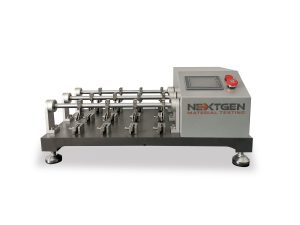
ISO 32100:2018 is a test method for determining the flex resistance of rubber- or plastics-coated fabrics in a folded condition using a flexometer-type apparatus.
It is commonly used to compare coated-fabric constructions and to check whether a coated textile can withstand repeated folding without unacceptable surface cracking, coating damage, or other visible deterioration. If you need help determining whether this method fits your product and thickness range, talk with our team.
ISO 32100:2018 — Rubber- or plastics-coated fabrics — Physical and mechanical tests — Determination of flex resistance by the flexometer method
This standard defines a laboratory procedure that repeatedly flexes a folded coated-fabric specimen while the fold travels back and forth along the test piece. The post-test appearance of the specimen is then used as the measure of flex resistance.
Quick definition
Document type: Test method.
Measured outcome: Visual condition of the coated fabric after a defined flex exposure (either a specified flex number or a specified number of flex cycles).
Key constraint: The method is intended only for products that can be clamped in the apparatus and can form a moving fold during the test.
What this standard covers
ISO 32100 covers a flexometer-based durability check for coated fabrics, focused on damage that develops when the material is repeatedly folded and the fold is forced to travel along the specimen.
The evaluation is appearance-based, so it is typically used to compare constructions, screen formulations, or qualify coated textiles for applications where repeated bending and folding are expected.
Why this standard matters in testing
Coated fabrics can fail in flexing long before they fail in simple tensile tests. ISO 32100 targets flex-driven damage modes such as cracking, embrittlement, coating fracture, or other visible surface breakdown that can occur under repeated folding.
For QA/QC and supplier qualification, the method can support lot-to-lot comparisons when the same apparatus configuration, clamping approach, and exposure level are used consistently.
Common materials, product types, or applications covered
This method is used for rubber- or plastics-coated textiles and similar coated fabric laminates where the coating and substrate interaction under folding is a performance concern.
Common application areas: Protective covers and flexible barriers, industrial curtains and partitioning, coated fabric components exposed to repeated bending during use, and other coated textile assemblies where flex cracking or coating damage is a risk.
Common test or verification workflow
Most lab workflows using ISO 32100 follow a consistent sequence: prepare specimens, clamp them into the flexometer so a folded region is created, run the exposure (by flex number or flex cycles), then inspect and document the specimen appearance after the exposure.
Practical caution: Because results are appearance-based, consistent inspection practices (including any magnification and lighting conditions specified in the standard) and clear pass/fail criteria are important for repeatable internal decisions.
Equipment commonly used for this standard
ISO 32100 points to a dedicated flexometer setup designed to repeatedly flex a folded specimen while driving the fold back and forth along the clamped test piece.
Common equipment elements: Flexometer unit (drive and counting/control), clamping fixtures matched to the specimen format, and inspection tools for post-test appearance evaluation.
If you are specifying a new flexometer or comparing clamp and control configurations, you can request a detailed quote for an ISO 32100-oriented setup.
How to read this designation or revision
ISO 32100:2018 refers to the ISO standard number (32100) and the publication year (2018). ISO also identifies this as Edition 2.
Revision sensitivity: Flexometer configuration details, specimen handling, exposure definition (flex number vs. flex cycles), and reporting/inspection requirements can vary by edition and by how the standard is invoked in a purchase specification. Match your lab procedure to the exact edition and customer requirement being cited.
Related standards, methods, or frameworks when useful
ISO 32100 is often used alongside broader physical/mechanical evaluation of coated fabrics (for example, tensile behavior, adhesion, and other durability checks) when qualifying a coated textile for service. When procurement documents cite multiple methods, confirm that the flex resistance requirement is specifically intended to be evaluated by the flexometer method described in ISO 32100.
Get help selecting an ISO 32100 test setup
If you need to align equipment, clamp style, and inspection approach to a specific ISO 32100 edition and your coated-fabric construction, contact our team to discuss your specimen format and acceptance criteria.