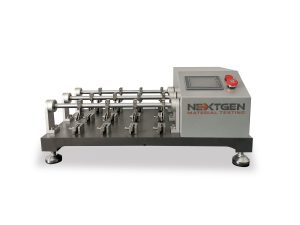
EN ISO 20344:2021 Section 6.6.3 defines the pre-treatment step used before measuring water vapour permeability (WVP) of footwear upper materials. It is used to simulate repeated flexing of the upper before breathability is measured.
This clause is typically referenced when a safety or occupational footwear program needs WVP results that reflect material performance after mechanical conditioning. If you need help aligning your flexing setup and WVP measurement approach to the exact edition cited in your specification, talk with our team.
EN ISO 20344:2021, Clause 6.6.3 — Pre-treatment test method (water vapour permeability)
Clause 6.6 of EN ISO 20344:2021 addresses water vapour permeability (WVP) for footwear upper assemblies (upper, lining, and tongue materials as applicable). Section 6.6.3 is the specific pre-treatment step performed before the WVP measurement step in Section 6.6.4.
This is a targeted conditioning method rather than a complete standalone test method: it prepares specimens so the subsequent WVP result is taken after controlled flexing.
Quick Definition
EN ISO 20344:2021 Section 6.6.3 is the pre-flexing (dry flexing) procedure applied to upper test pieces prior to measuring water vapour permeability (WVP).
Document type: Test-method clause within a larger test-method standard (EN ISO 20344).
What This Standard Covers
This clause covers the mechanical pre-treatment used to condition upper test pieces before WVP measurement.
Core requirement: Test pieces are flexed under dry conditions using a flexing method referenced to ISO 5402-1, using a defined number of flex cycles before WVP is measured.
What it does not cover: The WVP measurement itself (handled in EN ISO 20344:2021 Section 6.6.4, which references the WVP measurement approach), and product-level pass/fail criteria (typically set by the applicable footwear requirements standard or procurement specification).
Why This Standard Matters in Testing
Breathability claims and compliance checks often rely on WVP values. For protective footwear, it can be important to understand how an upper’s water-vapour transmission behaves after repeated bending similar to wear in service.
For labs and QA teams, Section 6.6.3 is where mechanical conditioning can change outcomes: pre-flexing can alter coatings, finishes, laminates, or micro-cracking behavior, which can affect the measured WVP in the next step.
Common Materials, Product Types, or Applications Covered
This clause is used when evaluating water vapour permeability of materials used in the upper assembly of PPE footwear.
Common materials: Upper leathers, coated textiles, laminates, lining materials, and tongue constructions (where sampled per the parent standard’s sampling plan).
Common applications: Safety footwear and occupational footwear breathability verification programs that reference EN ISO 20344 test methods.
Common Test or Verification Workflow
Section 6.6.3 is typically one step inside a larger WVP workflow.
Typical workflow: Cut representative test pieces from the upper area being evaluated → dry pre-flex the specimens using a flexometer method aligned to ISO 5402-1 for the specified number of cycles → proceed to the WVP measurement step (EN ISO 20344:2021 Section 6.6.4) and report WVP.
Practical caution: Because this clause ties the WVP result to a specific mechanical conditioning step, matching the flexing method details (fixture type, stroke geometry per the referenced flexometer method, cycle count, and dry conditioning state) is critical when comparing results between suppliers or test labs.
Equipment Commonly Used for This Standard
EN ISO 20344:2021 Section 6.6.3 points most directly to flexing equipment (with the WVP instrument selection driven by Section 6.6.4 and the referenced WVP measurement approach).
Common equipment for Section 6.6.3: Flexometer-type upper/leather flexing machine suitable for ISO 5402-1 style flexing, cycle counter, and appropriate specimen cutting tools/dies.
Common equipment for the follow-on WVP measurement step: A gravimetric water vapour permeability test setup (cup/container system), analytical balance, and a controlled conditioning environment (temperature/humidity control), consistent with the WVP measurement procedure referenced by EN ISO 20344.
If you are specifying a flexing machine and want to ensure the stroke, clamp set, and throughput match your footwear program, you can request a detailed quote for a configuration aligned to your specimen volume and reporting needs.
How to Read This Designation or Revision
How it is cited: Most test reports and procurement documents cite this clause as “EN ISO 20344:2021, 6.6.3” (often alongside 6.6.4 for the actual WVP measurement).
Edition sensitivity: The “:2021” year identifies the edition of EN ISO 20344. Some programs may cite EN ISO 20344:2021 with an amendment (for example “+A1”), so the lab should match the exact cited version when setting up pre-treatment and reporting.
Related Standards, Methods, or Frameworks
Section 6.6.3 is tied to two common companion methods in a typical WVP workflow.
Common related references: ISO 5402-1 (flexometer-based flexing used for the pre-treatment step) and ISO 14268 (water vapour permeability measurement method commonly referenced for WVP reporting and calculation approach).
Where it is used: EN ISO 20344 is the test-method backbone commonly referenced by protective footwear requirement standards (for example, safety and occupational footwear standards) that set performance thresholds and marking rules.
Get help aligning your WVP pre-treatment and equipment setup
If you are updating from an older edition, validating equivalency between labs, or building an in-house workflow that includes upper pre-flexing before WVP, contact our team to align equipment configuration, sample handling, and reporting references to the exact clause your program cites.