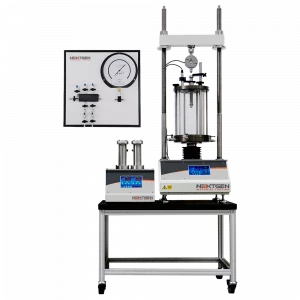
ASTM D2850 is a triaxial compression test method for cohesive soils run in an unconsolidated-undrained (UU) condition. It is widely used in geotechnical labs to characterize undrained shear strength and stress–strain response when drainage is not permitted during confinement and loading.
This method is commonly selected for short-term loading scenarios and for comparative strength checks on intact, compacted, or remolded cohesive specimens. If you need help aligning your test plan (UU vs. CU/CD) with your project assumptions, you can talk with our team.
ASTM D2850: Standard Test Method for Unconsolidated-Undrained Triaxial Compression Test on Cohesive Soils
ASTM D2850 describes a strain-controlled triaxial compression workflow performed without permitting drainage from (or into) the specimen during application of confining pressure or during axial loading.
The results are reported in terms of total stress (that is, the applied stresses are not corrected for pore-water pressure). This makes edition control and consistent specimen condition especially important when comparing results across projects or laboratories.
Quick Definition
ASTM D2850 is a laboratory UU triaxial compression test method used to determine undrained strength properties and stress–strain relationships of cylindrical cohesive-soil specimens under a specified confining pressure, with no drainage allowed.
What This Standard Covers
This standard focuses on triaxial compression testing of cylindrical cohesive soil specimens subjected to a confining fluid pressure in a triaxial chamber and then sheared axially at a constant rate of deformation.
Key coverage points: UU boundary condition (no drainage), strain-controlled axial loading, and total-stress interpretation of strength and stress–strain response.
Why This Standard Matters in Testing
ASTM D2850 is often chosen when the engineering assumption is “short-term loading” where drainage does not occur during the loading period. In that context, the undrained response can be more relevant than drained-strength parameters.
Because the measured strength depends on the pore pressure that develops during loading (while drainage is prevented), the test outcome is sensitive to specimen condition (for example, saturation/degree of saturation, water content, and fabric) and to consistent handling and loading control.
Common Materials, Product Types, or Applications Covered
ASTM D2850 is used for cohesive soils prepared as intact (undisturbed), compacted, or remolded specimens.
Common application areas: Geotechnical site characterization, embankment and slope assessments, temporary excavation/support evaluations, and comparative QC checks on cohesive fill materials where undrained assumptions are being used.
Common Test or Verification Workflow
A typical workflow under ASTM D2850 includes specimen preparation (intact/compacted/remolded), placement into a triaxial chamber, application of confining fluid pressure with drainage prevented, and axial compression at a controlled deformation rate until failure or a defined endpoint.
Typical outputs: Stress–strain curve information and an undrained (total-stress) strength result at the applied confining condition(s). When multiple confining pressures are used, total-stress Mohr circles and a corresponding envelope may be developed.
Equipment Commonly Used for This Standard
ASTM D2850 is equipment-driven: performance depends on stable confining pressure control, accurate axial load and deformation measurement, and a triaxial cell configuration suitable for cohesive-soil specimens.
Common equipment elements: Triaxial chamber (cell) with confining-pressure capability, load frame for axial compression, load cell, axial displacement measurement (for example, LVDT or encoder), pressure supply/regulator or pressure controller, and a data acquisition/control system capable of maintaining a constant axial strain rate.
If you are selecting a triaxial system or modernizing controls and instrumentation for UU testing, you can request pricing for a configuration matched to your confining pressure range, specimen size, and data requirements.
How to Read This Designation or Revision
Base designation: “D2850” identifies the ASTM standard number for this specific UU triaxial compression test method on cohesive soils.
Year suffix: A hyphenated year (for example, D2850-15) indicates the edition year tied to approval/revision. Because details can change between editions, procurement documents and lab reports should cite the exact edition used.
Related Standards, Methods, or Frameworks when useful
ASTM D2850 is commonly discussed alongside other cohesive-soil strength methods, depending on whether drainage and/or pore pressure measurement is required.
Common related references: ASTM D2166/D2166M (unconfined compressive strength of cohesive soils) and ASTM D4767 (consolidated-undrained triaxial testing with pore pressure measurement). ASTM D3740 is also commonly referenced for laboratory competence considerations in geotechnical testing.
Discuss ASTM D2850 testing and equipment options
If you want help matching ASTM D2850 to your specimen type (intact vs. compacted vs. remolded), confining pressure needs, and reporting expectations, contact our team to review your lab setup and test objectives.