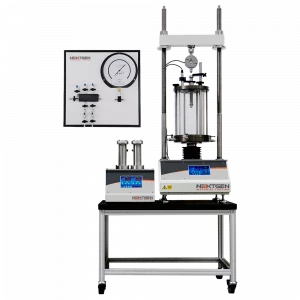
ASTM D4767 is a standard test method used in geotechnical laboratories to determine undrained shear strength and stress–strain behavior of saturated cohesive soils using a consolidated undrained (CU) triaxial compression test with pore-water pressure measurement.
It is commonly specified for design and verification work where soils consolidate under one stress condition and then experience a change in stress without time to drain, such as short-term loading scenarios in the field. If you need help matching the right edition to a project specification, talk with our team.
ASTM D4767 — Standard Test Method for Consolidated Undrained Triaxial Compression Test for Cohesive Soils
ASTM D4767 describes a strain-controlled triaxial compression procedure where a cylindrical cohesive-soil specimen is saturated, isotropically consolidated, and then sheared in compression under undrained conditions while monitoring pore-water pressure.
The results are typically used to develop total-stress and effective-stress interpretations (based on measured pore pressure) and to support strength and deformation evaluations used in geotechnical design.
Quick Definition
What it is: A consolidated undrained (CU) triaxial compression test method for saturated cohesive soils with pore-water pressure measurement.
What it outputs: Stress–strain response and undrained strength behavior, with data that can be used for total-stress and effective-stress analyses.
Why labs run it: To simulate undrained loading after consolidation to a defined confining stress, while capturing pore-pressure response during shear.
What This Standard Covers
ASTM D4767 covers testing of cylindrical specimens of saturated cohesive soil that may be intact (undisturbed), reconstituted, or remolded. The specimen is consolidated isotropically and then loaded in axial compression without drainage at a controlled rate of axial deformation.
The method relies on measurements of axial load, axial deformation, and pore-water pressure to support calculation of stresses and interpretation of undrained behavior during shearing.
Why This Standard Matters in Testing
In many projects, cohesive soils behave very differently depending on drainage conditions and stress history. A CU triaxial test helps characterize how strength and stiffness respond when the soil has time to consolidate first, but does not have time to drain during the loading phase.
Because pore-water pressure is measured, the test can support effective-stress interpretation in addition to undrained strength evaluation—often a key requirement for higher-confidence design parameters and for comparing material behavior across stress levels.
Common Materials, Product Types, or Applications Covered
ASTM D4767 is primarily used for cohesive soils that can be prepared and saturated as triaxial specimens, including many clays and clayey silts.
Common applications: Foundation and embankment design support, slope stability evaluations, earth-retaining structure design inputs, and verification of shear-strength behavior for cohesive soil strata where undrained loading conditions are relevant.
Common Test or Verification Workflow
A typical ASTM D4767 workflow in a geotechnical lab includes specimen preparation, saturation, isotropic consolidation to a target effective confining stress, and undrained axial shearing at a controlled deformation rate while recording pore pressure and stress–strain response.
Common workflow elements: saturation checks/conditioning, consolidation to selected stress states (often using multiple specimens to define behavior across stresses), undrained shearing with continuous data capture, and reporting of measured and calculated response for engineering evaluation.
Equipment Commonly Used for This Standard
ASTM D4767 typically points to a triaxial testing setup capable of saturation, confining-pressure control, and pore-pressure measurement during undrained shearing. Configuration details should be aligned to the project’s cited edition and the lab’s intended stress range and specimen size.
Common equipment: Triaxial load frame (strain-controlled), triaxial cell and pedestal/top cap set, confining-pressure supply/control, back-pressure and pore-pressure measurement hardware, load cell, displacement measurement, and data acquisition/control software.
Quoting caution: Pore-pressure measurement and pressure-control capability are central to this method, so equipment selection usually depends on the required pressure ranges, the control/recording channels needed, and whether the lab is running higher-throughput production testing or more instrumented R&D-style programs. If you are configuring a CU triaxial system for your target stress range and instrumentation level, you can request pricing for a matched configuration.
How to Read This Designation or Revision
ASTM standards are commonly cited by designation plus a year suffix that identifies the edition year (for example, “D4767-11”). Some citations also include a parenthetical year indicating a reapproval year (for example, “D4767-11(2020)”), and ASTM may also show a combined revision/reapproval identifier in standard records (for example, “D4767-11R20”).
Practical takeaway: Lab setup details, acceptance language in specifications, and reporting expectations can depend on the exact edition cited in a contract document—especially for instrumentation requirements and calculation/reporting conventions.
Related Standards, Methods, or Frameworks when useful
ASTM D4767 is part of a broader group of strength and deformation tests used in soil mechanics. In many specifications it is selected alongside other triaxial and shear methods depending on whether drained or undrained behavior is needed, and whether pore-pressure measurement is required.
Selection note: When a project specification mixes multiple shear-strength methods, it is important to confirm the intended drainage condition, consolidation condition, and whether effective-stress interpretation is required so the right test method and instrumentation are used.
Talk with a testing equipment specialist
If you are planning to run ASTM D4767 and want help aligning pressure-control ranges, sensor packages, and software channels to your lab workflow, contact our team to discuss your specimen sizes, target stresses, and reporting needs.