ASTM E18 is a set of standard test methods for determining Rockwell and Rockwell superficial hardness of metallic materials using the Rockwell indentation hardness principle.
It is commonly used for production and incoming inspection, process control, and acceptance testing where a fast, standardized hardness number is needed. If you need help aligning your part geometry, scale selection, and verification approach, talk with our team.
ASTM E18: Standard Test Methods for Rockwell Hardness of Metallic Materials
ASTM E18 describes how to perform Rockwell hardness tests and Rockwell superficial hardness tests on metallic materials, and it also includes requirements for the hardness testing machines used to generate reportable results.
Because Rockwell testing is widely used for shop-floor and lab hardness control, ASTM E18 is often referenced in material purchasing documents, heat-treatment verification, and quality plans where repeatability and traceability matter.
Quick Definition
Document type: Standard test methods.
In simple terms: A standardized way to measure Rockwell hardness (including superficial Rockwell) on metals, with defined expectations for test procedure and machine verification.
What This Standard Covers
ASTM E18 covers determination of Rockwell hardness and Rockwell superficial hardness of metallic materials by the Rockwell indentation hardness principle. It includes procedural requirements for making hardness measurements and requirements for Rockwell hardness machines.
It also addresses the use of portable Rockwell hardness testing machines when they can meet the standard’s requirements (including verification expectations). For portable Rockwell devices that can only be checked by indirect verification, ASTM E18 points users to ASTM E110.
Included supporting topics: Verification of Rockwell hardness testing machines, Rockwell standardizing machines, standardization of indenters, standardization of test blocks, guidance for minimum test piece thickness, and hardness corrections for convex cylindrical surfaces.
Why This Standard Matters in Testing
Rockwell testing is an empirical hardness method that is widely used because it is fast and practical for routine control of metallic materials. In many manufacturing environments, Rockwell hardness serves as a go/no-go check tied to processing conditions (for example, heat treatment) and is frequently used in acceptance testing.
ASTM E18 also highlights a key practical limitation: a hardness reading at one location may not represent the properties of an entire part. For quoting or test planning, this is a reminder to define where readings will be taken and whether multiple locations are needed to represent the product.
Common Materials, Product Types, or Applications Covered
ASTM E18 applies broadly to metallic materials where Rockwell or superficial Rockwell hardness is an appropriate measure, including common ferrous and nonferrous metals used in production parts and mill products.
Common use cases: Heat-treatment checks, receiving inspection of bar/plate/forgings, verification of machining or forming effects, and final QA checks on finished components where a standardized hardness scale is specified.
Common Test or Verification Workflow
ASTM E18 is often implemented as a controlled workflow that combines (1) selecting an appropriate Rockwell or superficial Rockwell scale for the material and condition, (2) preparing a suitable test surface and stable support, (3) performing measurements using a qualified machine and indenter, and (4) documenting results and verification status.
Common workflow elements: Define test location(s) on the part, verify the tester per the required approach, run test indents, and report results using the specified Rockwell scale designation in the purchasing or drawing requirement.
Equipment Commonly Used for This Standard
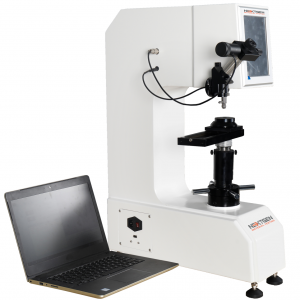
ASTM E18 typically points to Rockwell hardness testers (bench or floor models) and, where allowed and suitable, portable Rockwell hardness testers that follow the Rockwell indentation principle and can meet the verification requirements tied to the intended use.
Common equipment families: Rockwell hardness testers (regular and superficial), appropriate indenters (diamond and ball types depending on scale), certified Rockwell hardness test blocks for verification, stable anvils/fixtures for part support, and accessories for handling curved or small parts when needed.
For procurement and quoting, the most important equipment decisions usually revolve around which Rockwell scales you must run (regular and/or superficial), the size and geometry of the parts you need to support, and the verification approach expected by your quality system.
If you are specifying a new tester or upgrading for verification capability, you can request a detailed quote with your target scales, part sizes, and throughput.
How to Read This Designation or Revision
Base designation: “ASTM E18” identifies the standard within ASTM’s “E” series.
Year suffix: A suffix like “-25” (for example, ASTM E18-25) indicates the year of the most recent revision or adoption associated with that edition.
Why edition matters: Machine verification expectations, annex content, and reporting details can be edition-sensitive. When a customer or contract cites ASTM E18, it is good practice to confirm the exact edition year they require.
Related Standards, Methods, or Frameworks
ASTM E18 includes guidance and references that commonly come up alongside Rockwell hardness testing, especially for verification and for portable testing situations.
- ASTM E110: Cited for portable Rockwell hardness testing machines that cannot meet direct verification requirements and are confirmed by indirect verification.
Talk to a Rockwell hardness testing specialist
If you are implementing ASTM E18 for a specific part family (flat coupons, thin sections, curved surfaces, or large components), contact our team to align the tester type, fixturing approach, and verification plan with your requirement.