ASTM E18 is the primary ASTM test-method standard for Rockwell and Rockwell superficial hardness testing of metallic materials. It defines the Rockwell indentation hardness principle, outlines how tests are performed, and sets requirements for the hardness testing machine and verification.
If you need help matching Rockwell scales, indenter types, and verification expectations to your parts and lab workflow, talk with our team before you finalize an equipment plan.
ASTM E18: Standard Test Methods for Rockwell Hardness of Metallic Materials
Rockwell hardness is widely used in metals manufacturing and heat treating because it is fast, repeatable when properly controlled, and practical for production and laboratory checks. ASTM E18 is the standard that ties Rockwell results to defined forces, indenters, machine performance, and verification practices.
Because Rockwell hardness is an empirical indentation test, results are most meaningful when the same scale, machine condition, surface condition, and verification approach are used consistently.
Quick definition
ASTM E18 describes how to determine Rockwell and Rockwell superficial hardness of metallic materials by measuring indentation depth under a specified preliminary test force and total test force using a specified indenter.
What this standard covers
ASTM E18 covers both the test procedure and the testing system requirements needed to produce valid Rockwell hardness values for metallic materials.
Coverage includes: Rockwell hardness and Rockwell superficial hardness testing principles and procedures; requirements for Rockwell hardness machines; and requirements and guidance related to verification, standardized reference elements (such as test blocks), and related corrections or limitations described within the standard’s annexes and appendixes.
Portable testing note: ASTM E18 recognizes portable Rockwell hardness testing machines when they operate on the Rockwell test principle and can meet the requirements of the method, including verification requirements. Portable machines that cannot meet direct verification and are confirmed only by indirect verification are addressed in ASTM E110.
Why this standard matters in testing
Rockwell hardness is commonly used for quality control and material selection decisions in metals because it can provide useful comparative information that may correlate with properties such as tensile strength, wear resistance, and ductility.
ASTM E18 is frequently referenced for acceptance testing of commercial shipments. It also emphasizes an important practical limitation: hardness at a single location may not represent the entire part, especially for parts with gradients from heat treatment, surface treatments, or section-size effects.
Common materials, product types, or applications covered
ASTM E18 applies broadly to metallic materials where Rockwell or Rockwell superficial hardness is an appropriate indentation method.
Common applications: heat-treated steels and alloy steels; incoming inspection of bar, plate, forgings, and castings; hardness checks on finished machined parts; verification of heat treat outcomes on gears, shafts, fasteners, and tooling components; and general production/lab hardness control where Rockwell scales are specified.
Common test or verification workflow
ASTM E18 is typically used in a workflow that combines routine hardness testing with periodic verification of the system to maintain confidence in results.
Common workflow: select the specified Rockwell scale; prepare a suitable test surface and ensure stable part support; apply the preliminary test force, then increase to the specified total test force, then return to the preliminary test force to obtain a hardness value based on depth difference; run multiple impressions as needed for the part/test plan; and perform required machine verifications using standardized practices and reference materials appropriate to the method.
Force levels (Rockwell vs superficial): For the Rockwell hardness test (as distinct from superficial), ASTM E18 uses a preliminary test force of 10 kgf (98 N) and specifies total test forces of 60 kgf (589 N), 100 kgf (981 N), and 150 kgf (1471 N). Superficial Rockwell uses smaller forces and a shorter depth scale.
Equipment commonly used for this standard
ASTM E18 is equipment-sensitive: a Rockwell result is only as reliable as the machine condition, the indenter condition, the force application performance, and the verification approach.
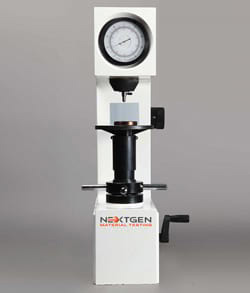
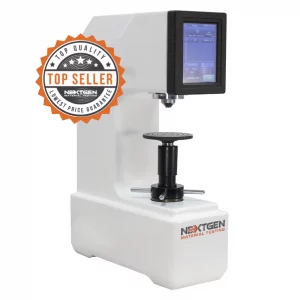
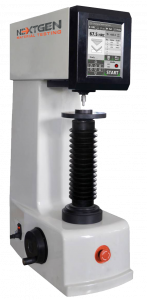
Common equipment: bench Rockwell hardness testers (regular and/or superficial); certified Rockwell indenters (diamond spheroconical and ball types as required by the selected scale); appropriate anvils and part-support tooling for stable seating; and Rockwell hardness test blocks used for verification practices.
Quoting caution: When selecting or quoting a Rockwell system, the key questions are usually which scales must be supported, whether superficial capability is required, what part geometry/support tooling is needed, and what verification approach is expected (including any needs tied to portable Rockwell testing). If you are comparing tester configurations or accessory packages, you can request a detailed quote matched to your required scales and verification workflow.
How to read this designation or revision
ASTM standards are cited by a fixed designation and a year-based suffix.
Designation format: “E18” is the fixed designation for this standard.
Year suffix: The number after the dash (for example, “-25”) indicates the year of original adoption or, if revised, the year of the last revision.
Reapproval and editorial markers: A year shown in parentheses indicates the year of last reapproval. A superscript epsilon (ε) indicates an editorial change since the last revision or reapproval.
Revision sensitivity: Equipment requirements and verification details can vary by edition, so purchasing, audits, and customer specifications should reference the exact cited year.
Related standards, methods, or frameworks
ASTM E18 is often used alongside other hardness and correlation references, depending on whether you are doing conversion, microhardness work, or portable testing under different verification constraints.
- ASTM E110: addresses portable Rockwell hardness testing machines that can only be checked by indirect verification.
- ASTM E140: hardness conversion tables used when specifications require conversions between hardness scales.
- ASTM E384: Knoop and Vickers microindentation testing, often used when section size, case depth, or microstructural features require smaller indentations.
- ISO 6508-1: commonly referenced internationally for Rockwell hardness test method requirements.
Get help selecting a Rockwell testing setup for ASTM E18
If you need a Rockwell tester configuration that aligns with the scales you run, the part geometries you support, and the verification expectations tied to your cited ASTM E18 edition, contact our team to talk through options before you commit to equipment.