ASTM E384 is a standard test method used to determine microindentation hardness using Knoop and Vickers indentation techniques. It is widely used when hardness needs to be evaluated over small distances, on small features, or in thin sections where conventional (macro) hardness methods are not practical.
Typical uses include checking case depth and gradients in heat-treated parts, mapping hardness across welds or coatings, and comparing microstructural regions in metals and other engineered materials. If you need help aligning your application, reporting expectations, and the correct test configuration, contact our team.
ASTM E384 – Standard Test Method for Microindentation Hardness of Materials
ASTM E384 provides a standardized approach for performing microindentation hardness measurements. The method is commonly applied when users need localized hardness values and repeatable results that can be compared across labs and production sites.
This standard focuses on how microindentation hardness testing is performed and how results are obtained and reported for Knoop and Vickers indents, including practical controls that help reduce variability when testing at small scales.
Quick definition
ASTM E384: A microindentation hardness test method that uses a diamond indenter (Knoop or Vickers) and optical measurement of the indentation to determine hardness at small feature sizes.
Common outputs: Knoop hardness (HK) and Vickers hardness (HV) values reported at a stated test force and dwell time, with additional notes as required by the test program.
What This Standard Covers
ASTM E384 covers microindentation hardness determination using Knoop and Vickers test methods. It is generally selected when the test objective is to measure hardness in a small area, evaluate gradients, or examine hardness changes across microstructural regions.
Because the indentation is small, the standard’s practical intent is to control factors that strongly influence results at micro scales—especially surface preparation, stable test force application, accurate optical measurement, and appropriate spacing away from edges or adjacent indents.
Why This Standard Matters in Testing
Microindentation hardness testing is often used as a fast, cost-effective way to compare material condition, process consistency, and localized mechanical response. In manufacturing and lab settings, ASTM E384 supports repeatable data collection for small features where macro hardness tests may average over too large an area or physically cannot be performed.
For quality programs, the most important practical benefit is comparability: when hardness is reported with the proper method (Knoop or Vickers), test force, dwell time, and measurement approach, results are much easier to trend over time and correlate to process changes.
Common Materials, Product Types, or Applications Covered
ASTM E384 is frequently used in metallurgical and materials labs for localized hardness evaluation. It is commonly applied to:
- Heat-treated metals where hardness varies with depth (for example, case-hardened components)
- Weldments and heat-affected zones (hardness mapping across the weld profile)
- Coatings and surface-modified layers where indentation size must be kept small
- Small parts, thin sections, and microstructural constituents where localized hardness is needed
Material preparation and mounting approach are often driven by the part geometry and the required measurement location, so the test plan should define exactly where indents must be placed and how close they can be to edges, interfaces, and prior indents.
Common Test or Verification Workflow
A typical ASTM E384 workflow follows a controlled sequence to reduce scatter from surface condition and measurement technique.
Common workflow: Select Knoop or Vickers → prepare and polish the test surface → choose the appropriate test force and dwell time → make multiple indents at defined locations and spacing → measure the indentation with an optical system → calculate and report hardness with full test conditions.
When the goal is hardness mapping (such as across a case depth or weld), the workflow usually adds a location plan (indent grid/line), documentation of the measurement positions, and averaging rules appropriate to the program requirements.
Equipment Commonly Used for This Standard
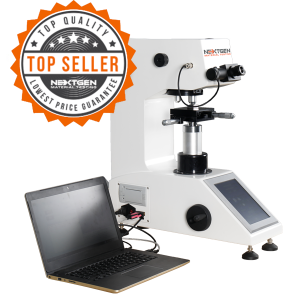
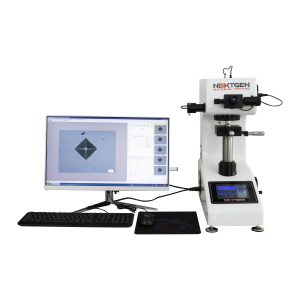
ASTM E384 commonly points to dedicated microindentation hardness testers or microhardness attachments capable of controlled low-force indentation and precise optical measurement.
Common equipment: Microindentation hardness testing machine (microhardness tester) with Knoop and/or Vickers diamond indenter(s), a stable test force application system, a microscope or optical measurement system (manual or automated), and a rigid sample stage/positioning system for accurate indentation placement.
Common accessories: Metallographic mounting and polishing equipment, fixturing to hold irregular parts, and software for automated measurement and hardness mapping where high throughput or traceability is required.
If you are selecting a microhardness tester, automation package, or imaging/measurement option for E384-style testing, you can request a detailed quote for a configuration matched to your materials and throughput.
How to Read This Designation or Revision
ASTM standards are commonly cited using the designation and a revision year (for example, ASTM E384-22). The year indicates the edition being referenced.
Revision sensitivity: Microindentation results can be sensitive to the details of machine performance, measurement approach, and reporting requirements. For procurement documents, customer specs, or compliance reporting, it is good practice to confirm the exact cited edition (including any year suffix) before finalizing test procedures or equipment requirements.
Related Standards, Methods, or Frameworks
ASTM E384 is often used alongside other hardness and metallography standards depending on the material system and the reason for testing.
Common related references: ASTM E92 (Vickers hardness testing) and ASTM E7 (metallographic terminology) are frequently used in the same lab workflows where microindentation hardness testing is performed and reported.
Talk with a microindentation hardness testing specialist
If you need help choosing between Knoop and Vickers, selecting an optical measurement approach, or matching a system to hardness mapping requirements, talk with our team about your material, geometry, and reporting needs.