ISO 2507-1:1995 defines a general test method for determining Vicat softening temperature on thermoplastics pipes and fittings using a loaded indenter while temperature is raised at a controlled, constant rate.
This standard is commonly referenced in plastics piping specifications and QA/QC programs to compare heat-softening behavior across materials or production lots. If you need help aligning your product requirement to the correct edition or companion part, you can talk with our team.
ISO 2507-1:1995 — Thermoplastics pipes and fittings — Vicat softening temperature — Part 1: General test method
ISO 2507-1 is an ISO test method focused on Vicat softening temperature (VST) measurement for thermoplastics pipes and fittings. The test uses a standard indenter under a specified force and tracks the temperature at a defined penetration depth.
The method is intended for thermoplastics materials where a rapid softening region can be measured with this approach, using test pieces taken from the wall of a pipe or fitting.
Quick Definition
ISO 2507-1 measures Vicat softening temperature by heating a specimen cut from a pipe or fitting while a loaded indenter presses into the surface; the reported result is tied to reaching a 1 mm penetration under the specified load.
What This Standard Covers
This standard specifies the general Vicat softening temperature test method for thermoplastics pipes and fittings.
Core concept: A standard indenter is applied to the specimen under a force of 50 N (with a defined tolerance in the standard) while the temperature is increased at a constant rate until the indenter penetration reaches 1 mm.
Specimen form: Test pieces are cut from the wall of a pipe or fitting (rather than molded plaques/sheets).
Method lineage: The approach is based on the Vicat method used for plastics materials in sheet form (ISO 306), adapted here for pipe and fitting wall specimens.
Why This Standard Matters in Testing
Vicat softening temperature is often used as a practical indicator of how a thermoplastics pipe or fitting material responds as it approaches its softening region under a small, standardized mechanical load. For many piping products, it supports material verification and helps maintain consistency across manufacturing lots.
From an equipment standpoint, ISO 2507-1 drives the need for stable temperature ramp control, a repeatable loading/indentation system, and reliable penetration measurement—since small differences in ramp conditions and measurement setup can shift the reported temperature.
Common Materials, Product Types, or Applications Covered
ISO 2507-1 applies to thermoplastics pipes and fittings where the Vicat method is suitable for capturing the rapid softening region.
Common product forms: Extruded thermoplastics pipe, molded fittings, and related components where specimens can be cut from the wall.
Where it shows up: Product specifications and qualification plans for plastics piping systems, especially where a referenced Vicat softening temperature requirement is used as part of material or product verification.
Common Test or Verification Workflow
ISO 2507-1 is typically used as a bench test within a broader incoming inspection, process control, or product qualification workflow.
Typical workflow:
- Cut test pieces from the pipe or fitting wall to the dimensions required by the standard and the applicable part/condition reference.
- Mount the specimen in the Vicat apparatus, apply the specified indenter and load, and establish the required starting conditions.
- Heat at the specified constant temperature increase rate while monitoring indenter penetration.
- Record the temperature when the indenter reaches 1 mm penetration and report the Vicat softening temperature per the standard’s reporting requirements.
Equipment Commonly Used for This Standard
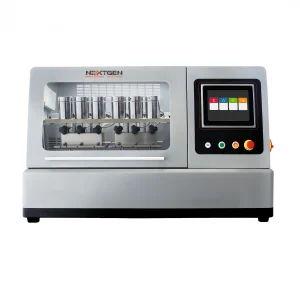
ISO 2507-1 generally points to Vicat softening temperature test equipment designed for controlled heating and precise indentation measurement.
Common equipment: Vicat softening temperature (VST) tester with controlled heating system (bath or chamber, depending on configuration), calibrated temperature sensing, an indenter assembly, and a loading system capable of the specified force.
Common accessories: Specimen cutting/preparation tools suitable for pipe/fitting wall sections, specimen supports/fixtures appropriate to the wall geometry, and verification tools for temperature and displacement/penetration measurement.
Quotation caution: Configuration details (such as the number of stations, the heating medium, and the measurement system) should be matched to the cited ISO 2507-1 edition and any referenced test-condition part used alongside it.
How to Read This Designation or Revision
ISO 2507-1 identifies Part 1 of the ISO 2507 series and is the general test method for Vicat softening temperature on thermoplastics pipes and fittings.
:1995 indicates the 1995 edition. ISO records note this edition was confirmed in 2017, and a consolidated ISO 2507 revision has been in development; for procurement documents and test reports, it is important to follow the exact edition and year cited in your requirement.
Related Standards, Methods, or Frameworks
ISO 2507-1 is commonly used alongside other ISO 2507 parts that specify material-specific test conditions for particular thermoplastics piping families, as well as the broader Vicat method used for plastics in sheet form (ISO 306).
If your requirement references a specific polymer family or a regional adoption (such as an EN ISO edition), confirm which companion document defines the exact test conditions to be applied with the Part 1 method.
Get help selecting a Vicat setup for ISO 2507-1
If you are equipping a lab for ISO 2507-1 testing and want to confirm the right Vicat configuration, number of test stations, and measurement options, you can request a detailed quote matched to your throughput and reporting needs.