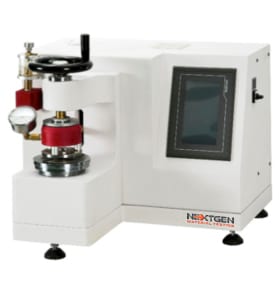
ISO 2759 is an ISO test method for determining the bursting strength of board by applying increasing hydraulic pressure until rupture. It is widely used for packaging boards and corrugated board components when burst performance is part of a material specification or incoming QC plan.
If you are not sure whether ISO 2759 (or an alternate burst method) is the right fit for your material grade and strength range, talk with our team about your application and the edition you need to match.
ISO 2759:2014 — Board — Determination of bursting strength
ISO 2759:2014 is an International Standard that defines a hydraulic diaphragm bursting-strength procedure for board. The result is reported as the maximum hydraulic pressure reached at rupture, and it is commonly used as a quick indicator of board robustness in converting, handling, and package performance.
This method is intended for board grades across a defined strength range and is also used for certain lower-strength papers/boards when they are used as components in higher-strength combined materials (such as corrugated board).
Quick definition
What it measures: Maximum hydraulic pressure at which a clamped board test piece ruptures (bursting strength).
How it works: A circular elastic diaphragm is hydraulically pressurized at a controlled rate, pushing against the specimen until it bursts.
Typical outputs: Bursting strength (pressure) and, when needed, a burst index based on grammage.
What This Standard Covers
ISO 2759 specifies a hydraulic burst test for board, including corrugated and solid fibreboard. The method is commonly applied within a bursting-strength range of 350 kPa to 5 500 kPa, and it can also be applied down to 250 kPa in cases where the material is used to produce a higher-burst-strength combined material (with appropriate caution in reporting).
Because the specimen is clamped and loaded by a diaphragm, results depend not only on the board itself, but also on clamping conditions, diaphragm behavior, pressure measurement, and the pressurization rate—making equipment condition and calibration important for meaningful comparisons.
Why This Standard Matters in Testing
Bursting strength is often used as an acceptance metric for packaging boards where resistance to multi-directional stressing and rupture is critical. It can support material qualification, supplier comparison, and routine QC release when a product specification references ISO 2759.
For labs supporting corrugated packaging supply chains, ISO 2759 is frequently used to assess linerboard and other components as part of broader performance targets (where burst is one of multiple properties alongside grammage, compression, and tear resistance).
Common Materials, Product Types, or Applications Covered
ISO 2759 is commonly specified for board and board components used in packaging and converting.
- Solid fibreboard and packaging board grades where burst strength is a purchasing requirement
- Corrugated board components (e.g., liners and mediums) evaluated as part of corrugated performance control
- Board used in cartons, sleeves, partitions, and protective packaging where rupture resistance is tracked
Common Test or Verification Workflow
ISO 2759 testing is typically run as a fast, repeatable bench test in a conditioned lab environment.
Common workflow: Sample per ISO sampling guidance, condition specimens in a standard atmosphere, clamp the test piece over the diaphragm, increase hydraulic pressure at a controlled rate to rupture, record maximum pressure, and report bursting strength (and, when required, burst index using grammage).
Common verification use cases: Incoming inspection, supplier qualification, product change control (fiber mix, caliper, coating), and routine production QC.
Equipment Commonly Used for This Standard
ISO 2759 points to a hydraulic diaphragm bursting-strength tester designed for board, with controlled pressurization and a defined clamping system. Exact hardware details matter because clamp geometry, clamping pressure, diaphragm condition, and pressure measurement all influence results.
Common equipment: Hydraulic bursting strength tester (diaphragm type), clamping fixtures sized for the specified test area, pressure measurement system (digital transducer or gauge as permitted by the method), and cutting tools for preparing test pieces.
Common lab support items: Conditioning room or chamber meeting standard atmosphere requirements, calibration tools/verification routines for the pressure measurement system, and (when burst index is required) a grammage determination capability aligned with ISO 536.
If you are selecting a burst tester for board ranges, throughput, or digital reporting needs, you can request a detailed quote for a configuration matched to your materials and test volumes.
How to Read This Designation or Revision
Standard number: ISO 2759 identifies the bursting strength method for board (hydraulic diaphragm method).
Year/edition: “ISO 2759:2014” indicates the 2014 edition (Edition 4). Many purchase specifications require the year to be stated because equipment requirements, reporting expectations, and precision statements can depend on the cited edition.
Status note: ISO 2759:2014 has been systematically reviewed and confirmed as current by ISO (most recently confirmed in 2025). Earlier editions (such as ISO 2759:2001) may still appear in legacy specifications, so edition matching is important when comparing data across sites or suppliers.
Related Standards, Methods, or Frameworks
ISO 2759 is commonly used alongside other paper and board references that control sampling, conditioning, and supporting measurements.
Commonly referenced with ISO 2759: ISO 186 (sampling), ISO 187 (standard atmosphere for conditioning and testing), and ISO 536 (grammage, used when calculating burst index).
Alternate burst method at lower strengths: ISO 2758 is a related burst method referenced for certain lower bursting-strength materials; if your specification is near the method boundary ranges, make sure the cited method is consistent across buyers, suppliers, and labs before trending results.
Get help choosing an ISO 2759 test setup
For board grades near the lower end of the ISO 2759 application range, clamp and calibration details can drive disagreements between labs. If you want help aligning equipment capability, reporting outputs, and the correct cited edition, contact our team with your material type and target burst range.