ISO 37:2024 is an ISO test method for determining tensile stress–strain properties of vulcanized rubber and thermoplastic rubber. It is widely used to generate tensile strength and elongation results for material qualification, incoming inspection, and product QA/QC.
Because grips, extensometry, and stroke needs can vary with rubber type and expected elongation, setup details matter for repeatable results—if you want help matching equipment to your specimen and reporting requirements, talk with our team.
ISO 37:2024 — Rubber, vulcanized or thermoplastic — Determination of tensile stress-strain properties
ISO 37 specifies a tensile testing method used to characterize how vulcanized and thermoplastic rubbers respond to uniaxial tension. It supports both routine production checks and engineering comparisons between compounds, formulations, or processing conditions.
Results from ISO 37 are commonly used in supplier/customer specifications, technical datasheets, and internal acceptance criteria where stress–strain performance is a key requirement.
Quick definition
ISO 37 is a tensile stress–strain test method for rubber materials that reports properties such as tensile strength and elongation at break, and can also report stress/elongation at specified points on the stress–strain curve.
Document type: Test method (International Standard).
Primary outputs: Tensile strength; elongation at break; stress at a given elongation; elongation at a given stress; and (for some thermoplastic rubbers/compounds) stress at yield and elongation at yield.
What this standard covers
This standard covers the determination of tensile stress–strain properties for vulcanized rubber and thermoplastic rubber materials. It is used to quantify how a rubber compound stretches and carries load up to yield (where applicable) and ultimately to break.
ISO 37 is focused on tensile behavior measured under controlled test conditions; it is not a durability, fatigue, tear, or environmental aging standard by itself, although it is often used alongside those methods in qualification programs.
Why this standard matters in testing
ISO 37 results are commonly used to compare compound-to-compound performance and to verify batch consistency. In production environments, it can function as a fast, quantitative check that formulation changes, cure state changes, or raw-material shifts have not degraded tensile performance.
For R&D, the stress-at-elongation and elongation-at-stress values are often used to compare stiffness behavior at practical strain levels (for example, at a specified elongation), rather than relying only on break values.
Common materials, product types, or applications covered
ISO 37 is applied to vulcanized rubber compounds and thermoplastic rubbers used across many industrial and consumer product areas where tensile performance is part of the material specification.
Common examples: Elastomeric seals and gaskets, molded rubber components, rubber sheet/strip stock, hoses and flexible components (material-level checks), and thermoplastic rubber parts where yield behavior may be relevant.
Common test or verification workflow
Most ISO 37 programs follow a straightforward lab workflow: prepare representative test pieces, condition them as required by the controlling specification, then run tensile tests to generate stress–strain data and the specified reported values.
Typical workflow: Define the property targets (e.g., tensile strength and elongation at break, plus one or more stress/elongation points) → verify specimen preparation and conditioning requirements → run tests on a constant-rate-of-traverse tensile system → calculate and report the required tensile values for acceptance or comparison.
Equipment commonly used for this standard
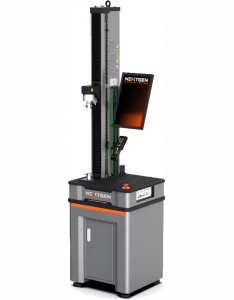
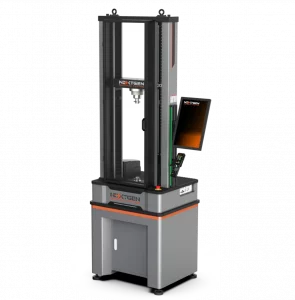
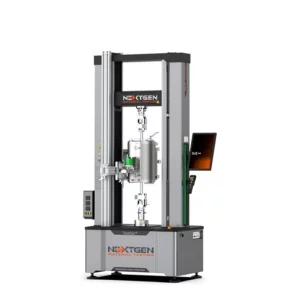
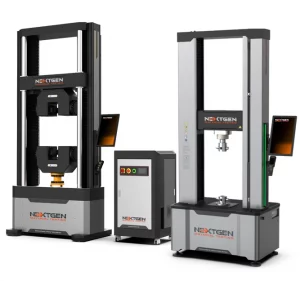
ISO 37 points to a controlled tensile test setup capable of stable force measurement over large extensions typical of rubber materials. Many labs also add extensometry choices that fit soft, high-elongation specimens.
Common equipment: Universal testing machine (tensile frame) with constant-rate-of-traverse capability; appropriate rubber grips/fixtures to minimize slippage or stress concentration; force measurement suited to the expected load range; and extension measurement (crosshead-based, contact extensometer, or non-contact/video extensometer depending on material behavior and reporting needs).
Common supporting tools: Specimen preparation tools (e.g., cutting/blanking solutions appropriate to rubber test pieces), dimensional measurement tools (thickness/width), and conditioning/environment controls when required by the test plan or procurement specification.
If you are selecting a frame capacity, grips, and strain measurement approach for rubber elongation ranges, you can request pricing for an ISO 37-ready tensile setup configured around your specimen type and reporting needs.
How to read this designation or revision
The designation is typically cited as “ISO 37” followed by a publication year (for example, ISO 37:2024). The year identifies the specific edition being used, which is important when requirements, definitions, or reporting expectations differ between editions.
Practical tip: When a customer specification calls out ISO 37, confirm whether it requires a specific year/edition and whether it includes additional requirements (conditioning, number of tests, reporting points, etc.) beyond the base method.
Related standards, methods, or frameworks when useful
ISO 37 is often used with companion rubber standards that address test piece preparation/conditioning and tensile test system requirements, especially when results are used for supplier agreements or inter-lab comparisons.
Often paired with: ISO 23529 (general procedures for preparing and conditioning rubber test pieces for physical test methods) and ISO 5893 (specification requirements for constant-rate-of-traverse tensile/flexural/compression test equipment used for rubber and plastics).
Get help selecting ISO 37 tensile testing equipment
If you need to match ISO 37 testing to your rubber type (vulcanized vs. thermoplastic), expected elongation range, and required reported values, request a detailed quote for a system configuration with the right load range, grips, and strain measurement approach.