ISO 75 is the ISO test-standard series used to determine a plastic material’s temperature of deflection under load (often referred to as HDT or DTUL). It is commonly used to compare heat-resistance performance under a defined flexural stress and heating rate for material selection, quality control, and product qualification.
If you need help aligning your material type and test conditions to the correct part of ISO 75 (and the right stress level), contact our team and we’ll help you map your requirement to a practical lab setup.
ISO 75 – Plastics — Determination of temperature of deflection under load
ISO 75 defines a standardized way to measure the temperature at which a test specimen, loaded in bending, reaches a specified deflection criterion while the temperature is increased in a controlled manner. Results are typically reported as a temperature value tied to a defined stress condition and method.
ISO 75 is widely referenced for thermoplastics and thermosets, including filled and fibre-reinforced plastics, because it provides a consistent comparison point for thermal softening behavior under load.
Quick definition
What it is: A flexural loading + controlled heating test used to determine temperature of deflection under load (HDT/DTUL) for plastics.
What you get: A deflection temperature reported for a defined method/stress condition and the cited ISO 75 part/edition.
What it’s used for: Comparing materials, supporting datasheets, checking lot-to-lot consistency, and verifying heat-resistance performance criteria used in product design.
What This Standard Covers
ISO 75 covers the determination of temperature of deflection under load using a bending specimen subjected to a constant flexural stress while the specimen temperature is increased at a controlled rate.
The ISO 75 series is structured so that one part provides the general method framework, and other parts provide material-specific requirements (for example, plastics and ebonite, or long-fibre-reinforced plastics and high-strength laminates).
Why This Standard Matters in Testing
HDT/DTUL testing is often used as a practical screening metric to compare how plastics resist deformation under load at elevated temperature. Because the method uses defined stress conditions, it is especially useful for comparing candidate materials under consistent settings rather than relying on qualitative heat-resistance claims.
For procurement and QA/QC teams, ISO 75 test results can be an actionable checkpoint for incoming material verification and for monitoring process or formulation changes that shift elevated-temperature stiffness behavior.
Common Materials, Product Types, or Applications Covered
ISO 75 is commonly applied to:
- Thermoplastics used in housings, brackets, clips, and under-hood components where deformation under heat is a concern
- Filled plastics and fibre-reinforced plastics (with requirements depending on fibre length and the ISO 75 part cited)
- Thermosetting laminates and long-fibre-reinforced plastics where higher structural performance is expected
- Ebonite (hard rubber), when ISO 75-2 is specified
Common Test or Verification Workflow
While details depend on the exact ISO 75 part and edition, a typical ISO 75 workflow includes selecting the applicable part, preparing/conditioning specimens as required, applying a defined flexural stress using a bending fixture, and heating the specimen in a controlled manner until the deflection criterion is reached.
Common reporting needs: Cited ISO 75 part/edition, the method/stress condition used, the measured temperature, specimen details, and key test conditions (for example, heating environment and temperature measurement approach as defined in the referenced document).
Equipment Commonly Used for This Standard
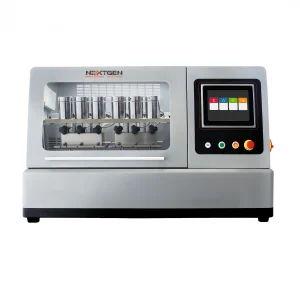
ISO 75 typically points to an HDT/DTUL test system built to apply a constant flexural load while controlling temperature rise and measuring deflection. The most common configuration is a dedicated deflection temperature under load instrument rather than a general-purpose universal tester.
Common equipment elements: Temperature-controlled heating chamber or bath, specimen stations, 3-point bending fixture(s), calibrated loading (to achieve the specified flexural stress), deflection measurement sensors, and data acquisition/control software.
If you are comparing station count, temperature range, or control/reporting features for ISO 75 work, you can request a detailed quote for a configuration matched to your throughput and materials.
How to Read This Designation or Revision
ISO 75 is published as a multi-part standard. In procurement documents and test plans, it is commonly cited with a part number and publication year (for example, “ISO 75-2:2013”).
Typical part structure: ISO 75-1 (general test method framework), ISO 75-2 (plastics and ebonite, including multiple stress methods), and ISO 75-3 (high-strength thermosetting laminates and long-fibre-reinforced plastics).
Revision sensitivity: Test setup and reporting expectations can vary by the exact part and edition cited, so equipment configuration and software templates should be aligned to the specific callout in your customer or internal specification.
Related Standards, Methods, or Frameworks
ISO 75 is often discussed alongside other heat-resistance and deformation-under-temperature evaluations for plastics. In some industries, it may be referenced next to analogous deflection-under-load methods from other standards bodies or alongside additional thermal characterization tests used for design and qualification.
When documents reference multiple heat-related metrics, it is important to keep the method-specific conditions separate (load/stress level, heating rate, specimen geometry, and the stated deflection criterion) rather than treating different methods as interchangeable.
Talk with a testing specialist
If you’re setting up ISO 75 testing for a new material family or need to match an existing report format, talk with our team about the right ISO 75 part, stress condition, and equipment configuration for your lab.