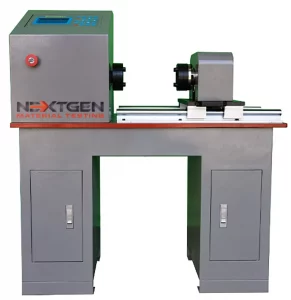
ISO 7800:2012 is an ISO International Standard for performing a simple torsion test on metallic wire. It defines a controlled way to twist a wire specimen in one direction around its axis and evaluate torsional ductility based on how the wire behaves and how many turns it withstands.
If you are not sure whether ISO 7800 is the right torsion requirement for your wire size, alloy, or purchase specification, talk with our team about scope and test setup fit.
ISO 7800:2012 — Metallic materials — Wire — Simple torsion test
ISO 7800 applies to metallic wire (including round wire and shaped wire) over a defined size range. The method is commonly referenced in wire product standards and procurement documents when torsional ductility, twist endurance, or twist-to-break performance must be demonstrated.
This standard is typically used as a production or incoming-inspection check for wire that will be formed, coiled, twisted, or otherwise subjected to torsional deformation in downstream manufacturing.
Quick Definition
Document type: Test method (simple torsion test for metallic wire).
What it evaluates: A wire specimen’s ability to undergo plastic deformation under one-direction torsion, commonly expressed as the number of turns achieved (to fracture or to a specified turn count).
Common output: Number of turns (and, when applicable to the setup, additional observations such as fracture appearance).
What This Standard Covers
ISO 7800 defines the principle of twisting a straight wire test piece about its own axis in one direction under controlled conditions. It addresses the testing equipment expectations, test piece handling (including straightness and preparation), and key test conditions such as grip alignment, speed control, and recording the number of turns.
It also supports use on both round wire (by diameter) and shaped wire (by characteristic dimension), and it is intended for relatively small wire sizes (from 0.1 mm up to 14 mm characteristic size).
Why This Standard Matters in Testing
Wire frequently fails in service or in forming operations due to torsional strain, surface damage, or insufficient ductility. A simple torsion test provides a fast, repeatable way to compare wire lots, confirm process stability, and screen for brittleness or manufacturing issues that may not be obvious from tensile testing alone.
Because torsion performance can be sensitive to test speed and specimen handling, using a recognized method like ISO 7800 helps labs and suppliers align on consistent acceptance testing and reporting.
Common Materials, Product Types, or Applications Covered
ISO 7800 is used for metallic wire products where twist ductility is important and is often specified alongside other mechanical checks.
Common materials: Steel wires, copper and copper-alloy wires, and aluminum and aluminum-alloy wires.
Common product types: Round wire and shaped-profile wire used for springs, strand/conductor components, formed wire parts, and general-purpose industrial wire where torsional deformation is expected.
Common Test or Verification Workflow
ISO 7800 is typically run as a routine mechanical verification in a lab or quality-control environment.
Typical workflow: Prepare a straight test piece to the required free length, clamp the specimen in aligned grips, apply any required axial/tensile condition if specified by the relevant product standard, twist at a controlled rate in one direction, and record the number of complete turns achieved (to fracture or to a defined endpoint).
Common reporting items: Wire size (diameter or characteristic dimension), free length between grips, test speed, any applied tensile condition, and the number of turns achieved. Some programs also record fracture observations when required by the calling specification.
Equipment Commonly Used for This Standard
ISO 7800 points to a torsion testing setup designed specifically for wire, with stable alignment and controlled rotation speed. In practice, equipment selection is driven by wire size range, required turn rate, and how the wire is gripped without introducing bending or surface damage.
Common equipment: Wire torsion testing machines or torsion frames with a rotating grip and a fixed (non-rotating) grip, turn counting/recording, and speed control appropriate for the standard’s tolerances.
Common fixturing: Wire grips/jaws selected by wire size and hardness, with jaw hardness and jaw-face style chosen to reduce slip while avoiding damage; protective shielding is commonly included to manage fracture fragments.
If you are configuring a torsion tester (or upgrading grips for a wider diameter range), you can request a detailed quote for an ISO 7800-oriented setup matched to your wire sizes and throughput targets.
How to Read This Designation or Revision
ISO 7800:2012 identifies the ISO 7800 standard and its publication year. Many purchase specifications cite the year explicitly, and test conditions (such as speed guidance and reporting expectations) can vary between editions.
Practical note: When ISO 7800 is referenced inside a wire product specification, the product specification may add acceptance criteria (for example, minimum turns) and may override selected test conditions. Always run to the exact edition and any additional requirements stated in the calling document.
Related Standards, Methods, or Frameworks when useful
ISO 7800 is often used as a referenced method inside material or product standards for specific wire types. Those documents typically define acceptance criteria (such as required turns) and may specify sampling plans or additional conditioning.
Common companion checks: Tensile testing, bend testing, dimensional inspection, and surface/defect evaluation are frequently used alongside torsion testing in wire qualification and QC programs.
Get help selecting an ISO 7800 torsion test setup
If you need help matching wire diameter range, grip style, turn-rate capability, and reporting outputs to an ISO 7800-based requirement, ask for a quote with your wire size range, material family, and target turns/throughput.