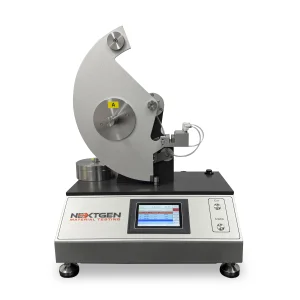
NF G07-149 is a French (NF) textile test method for determining the tear strength of woven fabrics using an initiated tear and a low-capacity pendulum tear tester.
If you are working from an older requirement that cites NF G07-149 and need help mapping it to a practical lab setup and report outputs, talk with our team.
NF G07-149 — Textiles — Fabric testing — Tear strength under “live force” (initiated tear), low-capacity pendulum
NF G07-149 describes a pendulum (ballistic) tear method used to measure the average force needed to continue an initiated tear in a fabric specimen. It is intended for cases where the tear propagates primarily by breaking yarns perpendicular to the tear direction.
This document is commonly encountered as a legacy reference in specifications and internal test plans. The exact test capacity and specimen dimensions matter, because the method is tied to a low-capacity pendulum range.
Quick Definition
In simple terms: Clamp a pre-notched fabric specimen in a pendulum tear tester and record the force required to propagate the tear over the defined tear length using a low-capacity pendulum.
Primary output: Average tear force (reported for the direction tested, commonly warp and weft as applicable).
What This Standard Covers
NF G07-149 establishes conditions and operating steps to determine tear resistance of fabrics using an initiated-tear pendulum method with a low-capacity instrument.
-
Test principle: Initiated tear propagation measured by pendulum energy/force response (Elmendorf-type approach).
-
Instrument capacity range: Low-capacity pendulum range (commonly cited as approximately 5 to 10 daN).
-
Specimen state options: Conditioned (standard atmosphere) specimens and wet specimens (by soaking) may be tested, depending on the requirement.
-
Applicability limits: The method is not intended for fabrics that fail primarily by yarn slippage/unweaving during the test or where the test produces an abnormal “strip-out” behavior instead of a controlled tear.
Why This Standard Matters in Testing
Tear strength is often used as a durability and damage-tolerance indicator for woven fabrics used in industrial, protective, and technical textile applications. NF G07-149 is especially relevant when a specification calls for a pendulum tear method and a lower force range is expected.
From an equipment standpoint, the key risk is range mismatch: if the fabric’s tear force is too low or too high relative to the pendulum scale, results can be unstable and may not meet the intended reporting quality.
Common Materials, Product Types, or Applications Covered
This method is used with textile fabrics where a tear can be initiated and then propagated in a controlled way by yarn rupture. Examples include many woven apparel, furnishing, and technical fabrics that do not primarily fail by yarn slippage under the test conditions.
It is less suitable for constructions that “open” without a clean tear (for example, structures that significantly ladder, detwist, or slip at the clamps), unless a separate requirement explicitly accepts that behavior.
Common Test or Verification Workflow
Most labs run NF G07-149 as a production or qualification check where tear resistance is a release criterion or a comparative durability metric.
Common workflow: Sampling and cutting → conditioning (or wet preparation) → verify instrument range → run multiple replicates per direction → calculate/report average tear force (and any required variation statistics if specified by the customer).
Range check: The selected pendulum should place results within a mid-scale region of the instrument (avoid running too close to the bottom or top of the scale) to support repeatable measurements.
Equipment Commonly Used for This Standard
NF G07-149 typically points to a pendulum tear testing setup sized for lower tear forces. Exact configuration depends on the expected tear force range and the specimen dimensions required by the method.
-
Pendulum tear tester (Elmendorf-type): Low-capacity pendulum(s) appropriate for the specified range, with compatible clamping jaws and calibrated scale/readout.
-
Specimen cutting tools: Cutting dies/templates and a press or cutting surface to produce consistent specimens and the required initiated-tear notch/slit.
-
Conditioning capability: Controlled atmosphere for textile conditioning when required by the test plan.
-
Wet testing accessories: Soaking container/timing control and handling tools for repeatable wet specimen preparation when wet-state testing is specified.
-
Verification tools: Basic checks for pendulum condition and calibration status to support defensible results.
If you are selecting a pendulum tear tester and need the right low-force capacity and accessory set for your fabric type, you can request a detailed quote based on your target tear-force range and throughput.
How to Read This Designation or Revision
NF: French national standard designation.
G07-149: Classification/index identifier within the NF textile testing standards series.
Edition sensitivity: NF G07-149 is published as a dated edition, and equipment setup details (including specimen dimensions and pendulum capacity selection) should follow the exact referenced edition in your requirement.
Related Standards, Methods, or Frameworks when useful
Some specifications pair NF G07-149 (low-capacity pendulum) with NF G07-148 for higher tear-force ranges. Where multiple pendulum capacities exist, the cited standard and the expected tear-force range should drive the selection.
Many labs also maintain capability for later international pendulum tear methods used for textiles; when cross-referencing requirements, always match the exact specimen geometry and reporting basis to avoid unintended differences.
Get help aligning NF G07-149 to your lab setup
If you need to match a customer or internal requirement that references NF G07-149—especially when deciding between low- and higher-capacity pendulum ranges—contact our team to discuss your fabric type, target force range, and reporting needs.